The issue of language policies occupies a significant portion of current discourse in Syria and poses an ongoing challenge for decision-makers in Damascus, considering the country’s rich language diversity across its geographical landscape. Since 2011, this diversity has further grown due to a large number of displaced Syrians and refugees in neighboring countries who have acquired new languages, particularly those living in Turkey and the Kurdistan Region of Iraq.
To date, the Syrian state has not formulated any policies aimed at managing its language diversity. Rather than supporting local languages and recognizing them as a means to foster a sense of belonging to a state that safeguards the cultural distinctiveness of its citizens, the Syrian government has imposed prohibitions on non-Arabic languages such as Kurdish, Syriac, Armenian, among others—despite the fact that speakers of these languages represent approximately 20% of the nation’s total population.
This paper aims to explore the consequences of the Syrian state’s language policies, particularly the phenomenon that may be described as “language genocide” against speakers of local languages such as Kurdish and Syriac. Furthermore, the paper will assess the approaches adopted by the new Syrian administration in dealing with language diversity and examine the potential implications of inclusive language policies on peacebuilding and the establishment of a modern state—one that respects the cultural identities of all citizens and allocates sufficient resources to safeguard these identities as a fundamental pillar for nurturing a shared sense of national belonging.
In light of the de facto situation on the ground, the Syrian Democratic Forces (SDF) and their administrative counterpart—the Autonomous Administration of North Syria—have taken control of a significant part of Syrian territory, which includes a large population of approximately four million individuals. This administration has established a language policy that diverges markedly from that of the central government, especially regarding the functioning of its institutions and the educational systems in the areas under its control, which also differ considerably from those in other regions of Syria governed by various de facto authorities.
In addition to its educational policy, the Syrian state has officially recognized only Arabic as the country’s sole official language and the exclusive language of education since the establishment of the modern Syrian state while systematically marginalizing and, in some cases, banning other languages spoken within Syria. These language policies have triggered a significant backlash from various language communities against the political authorities.
Following the collapse of Bashar al-Assad’s regime and amid the current interim administration’s approach to managing Syria’s societal diversity, new questions have emerged concerning the administration’s capacity to address this issue—an enduring challenge for any governing body in Syria. A central aspect of this challenge lies in how the administration engages with the Autonomous Administration in northeastern Syria, alongside its varying approaches to other critical issues, such as the IDPs and refugees.
To effectively address the question of language diversity in Syria, it is essential to move beyond rigid nationalist perspectives that frame the issue as a dichotomy between the language of the majority and those of minorities. Instead, it must be discussed from a viewpoint that does not perceive minorities as a threat to the existence of the state. Language demands should be understood as legitimate expressions contributing to the realization of equal citizenship and as fundamental components for reinforcing a sense of belonging to a state that respects the distinct identities of its citizens and allocates adequate resources to preserve and promote these identities.
This paper examines the language policies in Syria, including the educational frameworks that should be adopted for all components of Syrian society, irrespective of geographic or demographic distinctions, in order to achieve language justice for all language communities within the country. The paper is structured as follows:
- The first theme is an analysis of the political programs related to language policies proposed by various political frameworks in Syria, including the new administration, its key figures, and responsible bodies, as well as the Autonomous Administration of northeastern Syria Syria.
- The second theme is an exploration of the visions and frameworks that should be emphasized in dialogue and negotiations to enshrine language rights as constitutional principles, ensuring language justice for all communities. This section also considers how these policies might be implemented across the state institutions.
- The third theme discusses the complex intermingling of language groups in Syria, which requires a unique educational policy. In light of ongoing debates about political and administrative decentralization, the paper proposes that educational decentralization also be considered. It presents applicable models broadly for the Syrian context and for northeastern Syria particular.
- The fourth theme is evaluating the project of the Autonomous Administration in implementing language policies in northeastern It also involves determining whether these policies are aligned with the broader framework of language policies in Syria, and if they are, how that alignment manifests.
- The fifth theme involves presenting proposed solutions designed to create a fair educational policy that meets the needs of all language communities. It also outlines a potential framework for an educational system that could be adopted.
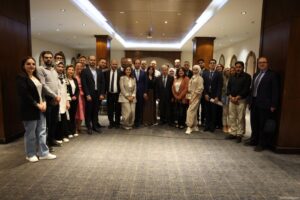
This study is grounded in primary sources obtained through a series of focus group discussions —three sessions each conducted in the cities of Qamishli, Raqqa, and Deir ez-Zor. Participants included officials from the Autonomous Administration, members of the education authority within the Autonomous Administration, representatives of active political parties (Arab, Syriac, and Kurdish), as well as experts in education and policies, civil society activists, and parents. In addition, the study draws upon open-source documents, reports, and academic research. These intersecting data sources were analyzed and critically examined.
Read more: Language Justice